
Gabion Baskets newsletter | April 2022 | Latest Installations

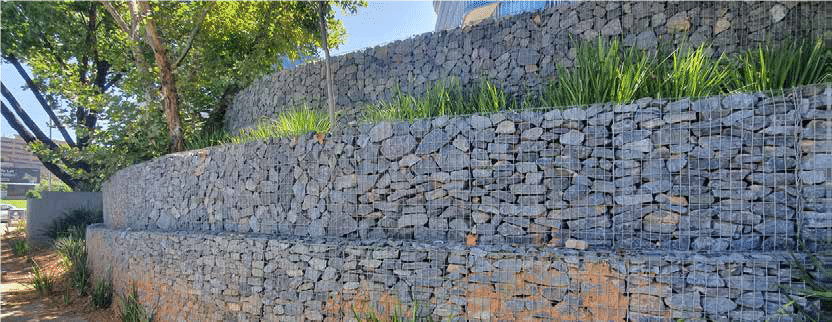
Our latest installation: An external freestanding wall of 2.7m high A visual tour of the destruction of the recent flooding at sites where Gabion Baskets have visited to offer advise and urgent rectification estimates Domestic Perimeter Walls Solutions and advise is offered on the installation of baskets, using mesh panels for freestanding or Architectural gabion […]
Gabion Baskets newsletter | March 2022 | Wood Chip Blankets

Gabion Baskets are excited to announce that we have our own locally produced biodegradable wood chip blanket. The woodchip blanket is used to combat soil erosion on exposed slopes, it stimulates vegetative growth while protecting topsoil and germinating seeds from the elements. Roll size is 50×2,45 m or 125m2 per roll. Used on steep slopes […]
Gabion Baskets newsletter | February 2022 | Secunda Gabion River Protection
Month one is already done for 2022 and our Gabion Baskets team are working full swing getting orders prepared and ready for dispatch. We are looking forward to great things this coming year and anticipate building on relationships with our customers that are already established. Looking at the many applications that Gabion Baskets can be […]
Gabion Baskets newsletter | January 2022 | Happy New Year!

Welcome back from a well deserved year end break. I am certain the New Year will bring with it hard work as well as success for us all. Let’s not let the past two years pull us down, but rather rise to the challenge and make every business transaction count towards a better and brighter […]
IMIESA March 2019

[vc_row][vc_column][vc_column_text] Environmental Engineering Gabion boxes and mattresses are flexible and able to endure for decades when founded in optimum conditions. Louis Cheyne, managing director of Gabion Baskets and a qualified construction materials specialist, expands on the best approach. By Alastair Currie Erosion is an insidious threat that can have devastating consequences. Examples include landslides and […]
Civil Engineering March 2018

Where there are soft soil conditions, geotextiles are an essential component of gabion installations; but with clay, the opposite is true. Then there’s the geotextile overlap. By Alastair Currie. Gabion walls constructed as freestanding structures are intended to serve as architectural features and not retaining systems. However, these walls still need a central steel support system and must be founded on concrete.
IMIESA March 2018 Gabions

Rivers follow their own course and will challenge any natural or man-made barrier. That’s a top-of-mind consideration for environmental engineers designing gabion structures and a key deliverable for the contractors that build these structures. By Alastair Currie
IMIESA January 2018 Gabions
Environmental engineers have a natural eye for the surrounding landscape and an expert understanding of how to use in situ materials to make seemingly simple but enduring installations. In Africa, they also provide a more affordable and labour-intensive solution. By Alastair Currie
Gabion Baskets Closing Times
[vc_row][vc_column][vc_row_inner][vc_column_inner width=”1/6″][us_separator size=”small”][/vc_column_inner][vc_column_inner width=”2/3″][us_image image=”6835″ align=”center” onclick=”lightbox” animate=”afc”][/vc_column_inner][vc_column_inner width=”1/6″][/vc_column_inner][/vc_row_inner][us_separator size=”small”][us_btn link=”url:https%3A%2F%2Fwww.gabionbaskets.co.za%2Fwp-content%2Fuploads%2F2018%2F11%2FIMIESA-January-2017-Gabion-for-approval.pdf||target:%20_blank|” align=”center” icon=”fas|download” style=”6″ label=”Download IMIESA January 2017 Gabion” custom_width=”200px” css=”%7B%22default%22%3A%7B%22font-size%22%3A%2218px%22%7D%7D”][/vc_column][/vc_row]
IMEISA October 2017 Gabions

Where there are soft soil conditions, geotextiles are an essential component of gabion installations; but with clay, the opposite is true. Then there’s the geotextile overlap. By Alastair Currie. Gabion walls constructed as freestanding structures are intended to serve as architectural features and not retaining systems. However, these walls still need a central steel support system and must be founded on concrete.